
Why the Slot-T Works for Struggling Programs
Why the Slot-T Works for Sub-.500 Programs

Introduction
For many sub-.500 programs, the problem is not effort.
It is not buy-in.
It is not even talent.
The problem is identity.
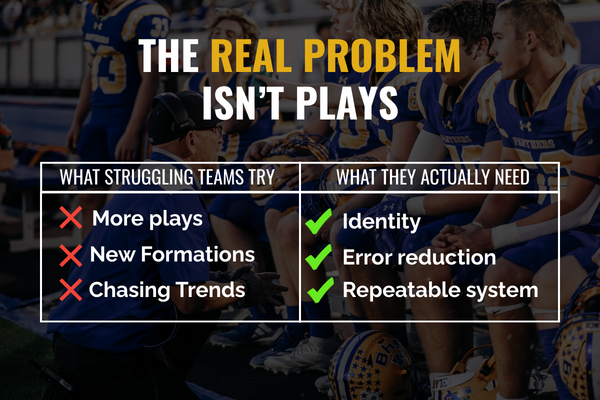
Year after year, struggling programs change plays, tweak formations, or chase the latest offensive trend hoping something finally sticks. What they rarely change is the underlying structure that puts players in constant conflict and asks them to execute beyond their current level.
The Slot-T offense succeeds where many systems fail because it gives sub-.500 programs something they desperately need: clarity, confidence, and control.
This article explains why the Slot-T works so well for struggling programs, what changes first when it is installed, and why it creates momentum long before the win-loss record catches up.
Sub-.500 Programs Don’t Lose Because They Lack Plays
Most struggling teams already have enough plays.
What they lack is:
A repeatable identity
A system that reduces mistakes
An offense that works even when execution isn’t perfect
Sub-.500 teams rarely lose because they are out-schemed. They lose because they beat themselves:
Bad snaps
Missed assignments
Hesitation
Negative plays
The Slot-T is designed to minimize damage while maximizing pressure. That combination is what makes it such a strong fit for turnaround situations.
The First Thing That Changes: Physical Confidence
When a struggling program installs the Slot-T, the first visible change is not points.
It is how the team moves.
Offensive linemen stop retreating.
Players stop waiting.
The offense begins attacking forward on every snap.
This matters because confidence in football is physical. When players are allowed to come off the ball aggressively instead of reacting, they gain belief quickly. That belief shows up in body language, practice tempo, and eventually results.
For sub-.500 programs, this shift alone can be transformative.
Why the Slot-T Stops Teams from Beating Themselves
One of the most overlooked advantages of the Slot-T is how it limits catastrophic plays.
In many systems, a single mistake can derail a drive:
A bad snap turns into a 15-yard loss
A missed read creates chaos
A blown protection kills momentum
The Slot-T reduces exposure to those moments.
A poorly blocked power run might still gain one or two yards.
A missed assignment often becomes traffic rather than disaster.
The offense stays on schedule.
For struggling teams, second-and-nine is survivable.
Second-and-28 is not.
The Slot-T keeps programs in manageable situations, which allows players to play freer and coaches to stay aggressive.
Why Lower Levels Improve First (and Why That Matters)
A consistent pattern emerges when sub-.500 programs install the Slot-T:
Middle school, freshman, and JV teams improve immediately.
This happens because:
The system simplifies decision-making
Fewer skills are asked at once
Mistakes are less punishing
Younger players stop overthinking. They learn to move fast, trust landmarks, and play together. Wins follow quickly at those levels.
That matters because confidence compounds. When younger teams start winning, the entire program begins to believe change is possible.
By the time those players reach varsity, the identity is already established.
The Slot-T Gives Every Player a Role
Sub-.500 programs cannot afford to waste players.
The Slot-T excels at creating meaningful roles for kids who might disappear in other systems:
Undersized linemen
Tough, athletic non-skill players
Players without elite measurables
High-effort kids who want to contribute
Instead of asking players to fit a prototype, the Slot-T assigns purpose. When more players feel essential, buy-in increases across the roster.
That buy-in is culture, not slogans.
Why Identity Matters More Than Play Count
Struggling programs often try to solve problems by adding complexity.
More plays.
More checks.
More tags.
The Slot-T does the opposite.
It gives the program a clear answer to the question:
“Who are we?”
That identity simplifies everything:
Practice planning
Player communication
Game-day decision-making
Players stop guessing what the offense is trying to be. They know. And that certainty shows up under pressure.
For sub-.500 teams, clarity is power.
Speed Creates Margin for Error
The Slot-T is built on speed off the ball. That speed matters even more for teams that are rebuilding.
Why?
Because speed creates margin for imperfection.
A perfectly blocked play at half speed can fail.
An imperfectly blocked play at full speed often succeeds.
Struggling programs rarely lose because they are lazy. They lose because they hesitate. The Slot-T removes hesitation by demanding commitment and movement every snap.
That urgency covers flaws while the program grows.
The Psychological Shift: From Hoping to Expecting
One of the most important changes for sub-.500 programs is psychological.
When teams install the Slot-T and see early success — even small success — expectations change. Players stop hoping something good happens. They start expecting it.
That shift alters:
How players practice
How they respond to adversity
How they carry themselves
Momentum follows belief, not the other way around.
Why the Slot-T Scales as the Program Improves
Some coaches worry that the Slot-T might cap their ceiling.
In reality, the opposite is true.
As fundamentals improve, timing sharpens, and repetition accumulates, the system becomes more dangerous. The same principles that stabilize struggling teams create explosive teams once confidence and discipline catch up.
This scalability is why the Slot-T is not just a rescue plan — it is a long-term solution.
How This Fits the Bigger Slot-T Picture
To fully understand why the Slot-T works for struggling programs, it helps to understand what the system actually is at its core.
If you have not already read it, start with:
What the Slot-T Offense Really Is (Article #1)
And if objections or skepticism remain, continue with:
Common Misconceptions About the Slot-T Offense (Article #2)
Together, those pieces explain why the Slot-T succeeds where other systems stall.
Conclusion
Sub-.500 programs do not need more complexity.
They need clarity, structure, and belief.
The Slot-T works because it:
Reduces mistakes
Builds physical confidence
Creates roles for more players
Establishes a clear offensive identity
Winning does not come overnight. But momentum does. And momentum changes programs.
For teams tired of being average or worse, the Slot-T offers something rare in football: a system designed to lift programs up, not sort them out.
Understanding why it works is the first step. Learning how to run it correctly is another conversation entirely.
