
Common Misconceptions About the Slot-T Offense
Common Misconceptions About the Slot-T Offense

Introduction
Few offensive systems in football are as misunderstood as the Slot-T offense.
For decades, coaches have attached labels to it that don’t reflect what actually happens on the field. Some see it as outdated. Others dismiss it as slow or predictable. Many assume it only works with a specific type of roster.
Those assumptions usually come from watching the Slot-T run incorrectly, or from seeing fragments of the system without its underlying identity.
Understanding the common misconceptions about the Slot-T offense is critical for any coach evaluating whether it fits their program. The truth is that most criticisms of the Slot-T are not criticisms of the system itself — they are critiques of poor implementation or shallow understanding.
This article addresses the most common myths head-on and explains what the Slot-T really is, and what it is not.
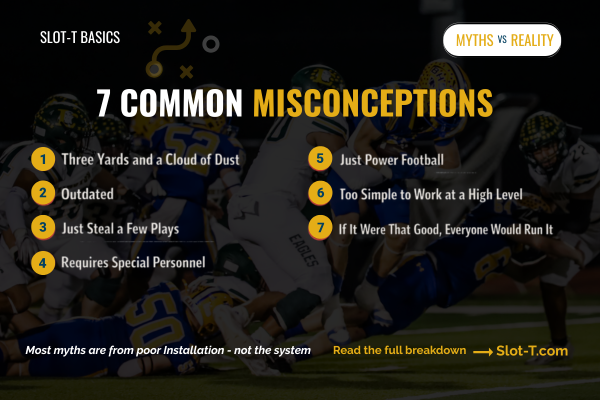
Misconception #1: “The Slot-T Is Three Yards and a Cloud of Dust”
This is the most persistent and damaging myth surrounding the Slot-T offense.
The phrase suggests slow pace, conservative play calling, and an offense designed merely to survive. That description could not be further from the truth.
The Slot-T is an explosive running offense built on speed, angles, and defensive stress. Big plays are not accidental. They are expected outcomes when defenders take false steps or chase the wrong keys.
The misconception comes from confusing power football with slow football. The Slot-T uses power concepts, but it executes them with tempo and misdirection. When defenders overcommit or trigger downhill too aggressively, creases appear — and those creases can turn into long touchdowns.
Calling the Slot-T “three yards and a cloud of dust” ignores how often it produces 20-plus-yard runs when run correctly.
Misconception #2: “The Slot-T Is Outdated”
Another common criticism is that the Slot-T is a relic of an earlier era.
This argument usually assumes that offensive systems must evolve by mimicking whatever is popular at the highest level of football. Spread concepts rise, spread concepts fall, and coaches chase trends.
The Slot-T is not trend-based. It is defender-based.
Its principles are built around how defenders react:
Linebackers reading guards
Safeties triggering on flow
Defensive ends squeezing or widening
Second-level defenders chasing backfield action
Those reactions have not changed.
As long as defenses rely on keys and reads, misdirection and conditional answers remain effective. The Slot-T is not trying to win a schematic arms race. It is trying to put defenders in conflict repeatedly until they are wrong.
That is not outdated. That is timeless.
Misconception #3: “You Can Just Steal a Few Slot-T Plays”
Many coaches believe they can borrow a handful of Slot-T concepts and plug them into their existing offense.
Sometimes that works in isolated situations. Most of the time, it does not.
The Slot-T is not a collection of good plays. It is a complete order of football. Timing, language, cadence, and backfield behavior are interconnected. When those elements are stripped away, the plays lose their effect.
This is why partial adoption often leads to disappointment. Coaches may blame the offense when the real issue is that the system was never fully installed.
The most successful Slot-T programs commit to it as an identity, not as a package.
Misconception #4: “The Slot-T Requires Special Personnel”
Another frequent concern is roster fit.
Some coaches assume the Slot-T only works if they have:
A dominant fullback
Large offensive linemen
A specific body type at every position
In reality, the Slot-T is known for creating players, not filtering them out.
Undersized linemen thrive because they block on angles instead of in isolation. Athletic but undersized backs find roles where quickness and decisiveness matter more than raw size. Players who might struggle to find touches in other systems often become productive contributors.
This adaptability makes the Slot-T especially effective for small-school programs, but it is not limited to them. The system maximizes what a roster has instead of punishing what it lacks.
Resource: Do You Have a Slot-T Roster?
Misconception #5: “The Slot-T Is Just Power Football”
Power is part of the Slot-T, but it is not the defining feature.
The defining feature is misdirection layered onto power.
Backfield action matters as much as blocking. Fakes are not decoration. They are functional tools that pull defenders out of position. When all 11 offensive players move with intent, the defense must sort through chaos in real time.
This is why the Slot-T is so difficult to prepare for. Defenses cannot key on one back or one action. They must account for everything, every snap.
That constant strain creates mistakes.
Misconception #6: “The Slot-T Is Too Simple to Work at a High Level”
Simplicity is often mistaken for weakness.
The Slot-T is simple in its language and structure, but it is complex in effect. Defensive coordinators must account for multiple threats without knowing which one matters most on a given snap.
The offense does not win by overwhelming players with information. It wins by forcing defenders to make rapid decisions under pressure.
Simplicity on offense often creates complexity for the defense. That is not a flaw. It is the point.
Misconception #7: “If It Were That Good, Everyone Would Run It”
This argument assumes that football systems spread purely on merit.
In reality, systems spread based on:
Familiarity
Coaching pipelines
Media exposure
Comfort level
The Slot-T requires commitment. It requires belief in fundamentals, repetition, and identity. Not every coach wants that level of buy-in.
That does not limit the system’s effectiveness. It limits its adoption.
Many coaches who dismiss the Slot-T do so without ever fully understanding how it works or why it works.
Why These Misconceptions Persist
Most Slot-T misconceptions come from three sources:
Watching incomplete versions of the offense
Seeing teams that lack timing and discipline
Judging the system without understanding its philosophy
When the Slot-T is run poorly, it looks ordinary. When it is run correctly, it looks overwhelming.
The difference is not the plays. It is the commitment to the system.
How Understanding These Myths Helps Coaches Decide
Coaches evaluating the Slot-T do not need to be convinced it is perfect. No offense is.
What they do need is an honest understanding of what the Slot-T actually offers:
Identity
Adaptability
Explosive potential
Program-wide consistency
Clearing away misconceptions allows coaches to evaluate the offense on its real merits, not on secondhand narratives.
Conclusion
The Slot-T offense has survived and thrived because it attacks how defenses think, not because it chases trends.
Most criticisms of the Slot-T are not about the system itself. They are about partial commitment, misunderstanding, or poor execution.
When coaches move past the myths and evaluate the Slot-T honestly, they often discover an offense built on clarity, speed, and pressure — not conservatism.
Understanding the Slot-T is the first step. Running it correctly is another conversation entirely.
